
Customer work · HR Technology and SaaS

PeopleStrong moved enterprise HR analytics from Cloudera to BigQuery

BluePi and PeopleStrong migrated a large HR and payroll analytics estate from Cloudera to Google Cloud. Report response time fell from 15–30 minutes to under 5 minutes, analytics refresh fell from 8 hours to 30 minutes, and the platform supports more than 500 report executions per hour.

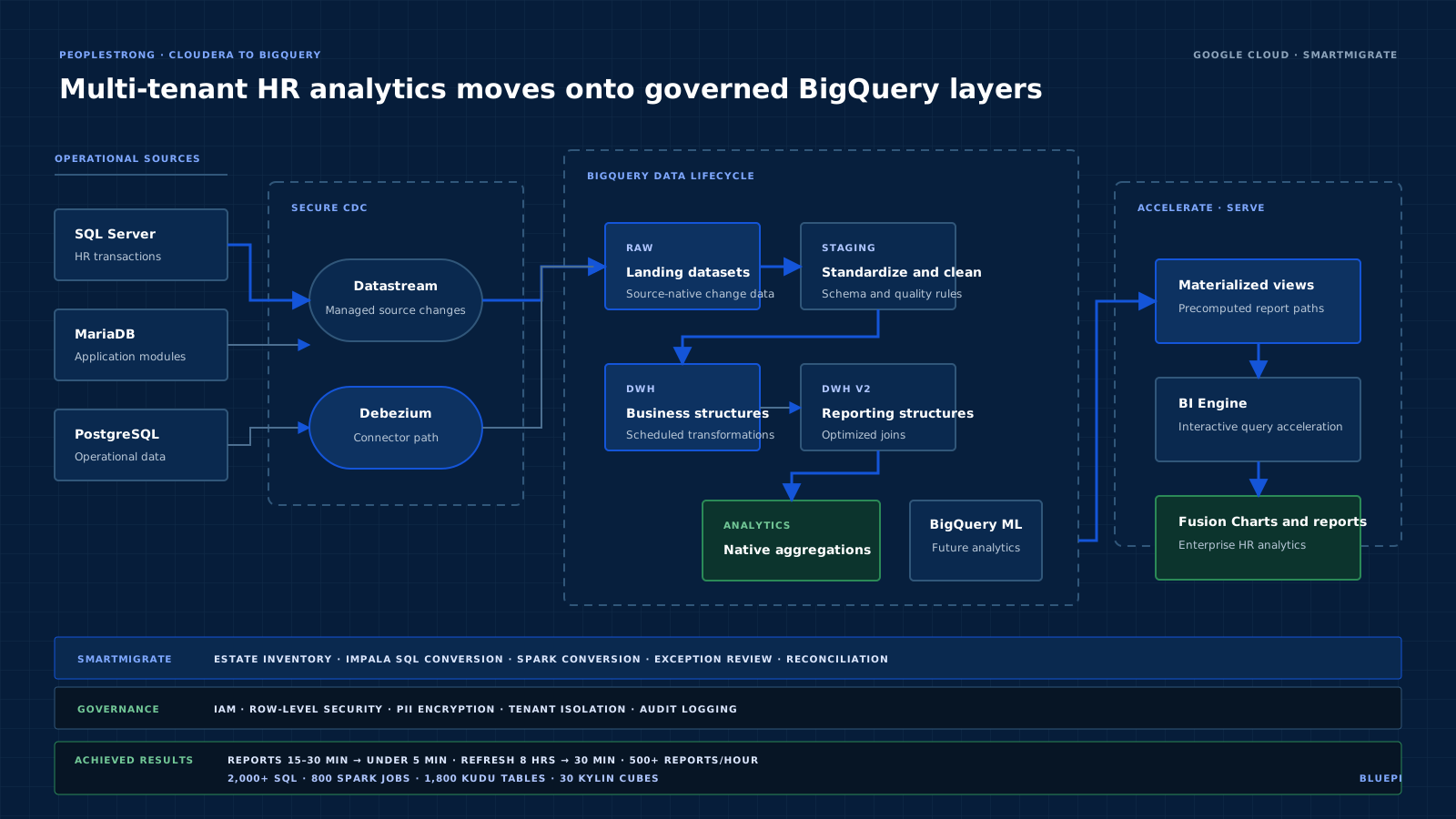
PeopleStrong moved enterprise HR analytics from Cloudera to BigQuery system diagram

Reporting moved off the shared Cloudera bottleneck

PeopleStrong’s HR and payroll analytics estate supported complex multi-tenant reporting. Shared-cluster contention, long queries, and Kylin maintenance limited report performance and data freshness. BluePi combined SmartMigrate automation with engineering review to move ingestion, transformation, reporting, and analytics workloads to BigQuery.

01 · Shared-cluster reporting bottleneck

The Cloudera environment carried thousands of SQL queries, hundreds of Spark jobs, Kudu tables, Kylin cubes, and customer-specific reports. Peak-hour contention pushed report response to 15–30 minutes, while analytics refresh could take 8 hours.

02 · SmartMigrate and BigQuery migration

A Google Cloud data platform used Datastream and Debezium for change data capture, BigQuery for storage and analytics, and native BigQuery features to replace Kylin. SmartMigrate supported workload inventory, SQL conversion, incompatibility detection, and reconciliation.

03 · Report and refresh performance

Report response fell below 5 minutes. Analytics refresh fell to 30 minutes, and the platform supports more than 500 report executions per hour.

From legacy estate to governed BigQuery analytics

BluePi inventoried the Cloudera estate, converted supported workloads, kept incompatibilities visible for engineering review, reconciled source and target behavior, and released migration waves under multi-tenant security controls.

Know the estate before converting it

Dependencies, schedules, security requirements, and customer-specific behavior entered the same inventory as the SQL, Spark, Kudu, and Kylin workloads.

Automate repeatable conversion

SmartMigrate converted eligible SQL patterns and identified exceptions. Engineers reviewed unsupported logic, performance-sensitive queries, and workloads whose behavior depended on the source engine.

Prove business equivalence

Source-to-target reconciliation compared schemas, counts, aggregates, report outputs, and multi-tenant behavior before cutover.

Where this pattern fits

This pattern fits organizations moving a large analytical estate where query conversion is only one part of the risk. The migration also needs dependency discovery, business-result reconciliation, security validation, report testing, and controlled cutover.

Review your migration estate

Case details

Open a section to review the customer problem, implementation, business change, and architecture.

01The starting point

PeopleStrong needed to improve reporting performance and data freshness while preserving the behavior and protection of a multi-tenant HR and payroll platform.

  • Large legacy estate: The platform included more than 2,000 Impala SQL queries, 800 Spark jobs, 1,800 Kudu tables, and 30 Kylin cubes.
  • Slow peak-hour reports: Report generation took 15–30 minutes during busy periods.
  • Long refresh cycle: Analytics refresh could take 8 hours.
  • Shared-cluster contention: Reporting and transformation workloads competed for the same Cloudera resources.
  • Complex query logic: Important reports included multi-join, parameterized, and customer-specific behavior.
  • Sensitive data: HR and payroll workloads required encryption, access control, auditability, and tenant isolation.
02What BluePi built

BluePi created a migration path from Cloudera to a governed BigQuery platform.

  • Source ingestion: Datastream and Debezium captured changes from SQL Server, MariaDB, and PostgreSQL.
  • BigQuery landing: Source records entered governed raw and landing datasets.
  • Layered transformation: BigQuery transformations populated staging, DWH, DWH V2, and analytics layers.
  • SmartMigrate conversion: The accelerator analyzed and converted eligible Impala SQL workloads.
  • Spark modernization: Spark transformations moved to BigQuery SQL and scheduled processing.
  • Kylin replacement: BigQuery native aggregations, materialized views, and BI Engine replaced the cube layer.
  • Exception review: Unsupported patterns remained visible for engineering analysis.
  • Reconciliation: Source and target outputs were compared before cutover.
  • Security: IAM, row-level security, encryption, audit logging, and tenant isolation protected HR and payroll data.
  • Controlled cutover: Migration waves used parallel validation and explicit release criteria.
03Results

The migration improved report performance, analytics freshness, throughput, and platform maintainability.

  • Report response below 5 minutes: Peak response improved from 15–30 minutes.
  • Analytics refresh reduced to 30 minutes: The previous refresh cycle could take 8 hours.
  • More than 500 report executions per hour: The BigQuery platform supports concurrent enterprise reporting demand.
  • Large estate migrated: The program covered more than 2,000 SQL queries, 800 Spark jobs, 1,800 Kudu tables, and 30 analytics cubes.
  • Lower Cloudera and Kylin dependency: BigQuery native services replaced maintenance-heavy analytical components.
  • Stronger governance: Multi-tenant controls, encryption, IAM, and audit logging became part of the target architecture.
“BluePi brought strong technical expertise and execution discipline to our data platform modernization initiative. Using their SmartMigrate accelerator, the team helped streamline the migration of 2,000+ SQL queries, 800 Spark jobs, and 30 analytics cubes from Cloudera to BigQuery.”
PeopleStrong

System diagram