
Capture contract
Define accepted devices, sites, orientation, resolution, lighting, motion, obstruction, event metadata, quality gates, and the safe route for unusable input.
Captured evidence to reviewed action
BluePi builds computer vision as a controlled path from image or video capture to a business action. The system makes capture quality, model version, confidence, review status, workflow effect, and corrected outcome visible.
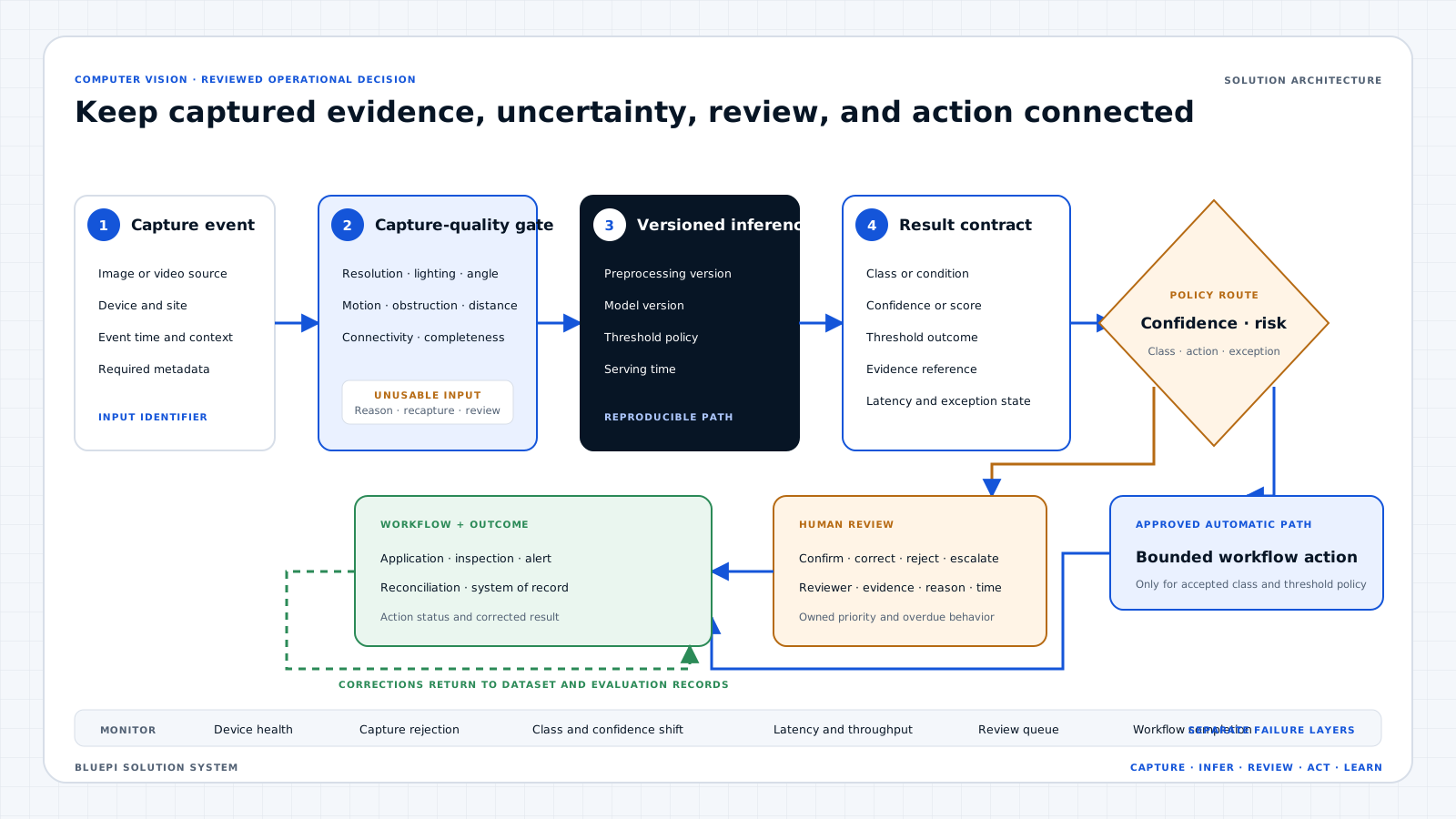
Computer vision inside an operating workflow
A production vision system includes the capture boundary, dataset record, model and threshold, evidence attached to each result, review path, workflow integration, and monitoring.
The release decision depends on the action and its error cost. Defect detection, event recognition, inspection, document capture, and reconciliation require different classes, latency, confidence, and review policies.
Define accepted devices, sites, orientation, resolution, lighting, motion, obstruction, event metadata, quality gates, and the safe route for unusable input.
Test the complete response path by class, site, device, operating condition, threshold, latency, review load, rare case, and false-positive or false-negative cost.
Publish a versioned result with evidence and exception state, route uncertainty to a named reviewer, and record the reviewed action and corrected outcome.
When this is the right starting point
Good fit
One operating workflow has a named owner, a measurable baseline, and users who can judge whether the result improves.
Poor fit
The request is capacity-only staffing, an unowned demonstration, or a broad transformation without a first decision and finish condition.
Evidence produced during delivery
Open the part you need. Each section expands into the full delivery scope for that step.
Start with the event or condition the system must identify, the actor who uses the result, the required response time, and the consequence of a false positive, false negative, delayed result, or unsupported input.
The input contract records device, site, orientation, resolution, frame rate, lighting, motion, obstruction, distance, connectivity, event time, and required metadata. A capture-quality gate checks whether the input is usable before inference. Rejected or incomplete inputs receive a reason code and a route for recapture, review, or safe failure.
The dataset records where each image came from, which operating condition it represents, who or what produced the label, how disagreements were resolved, and which dataset version entered training or evaluation.
Evaluation covers the capture gate, preprocessing, model, threshold, serving path, review queue, and business action together.
Each inference result contains the input and event identifiers, model version, predicted class or condition, confidence or score, threshold outcome, processing time, evidence reference, and exception state.
High-confidence results can enter an approved automatic action. Low-confidence, conflicting, unsupported, or high-risk results enter a review queue with the captured evidence. Reviewers can confirm, correct, reject, or escalate the result, while the system records the reviewer, evidence, decision, reason, and time.
The reviewed result reaches the application, reconciliation process, inspection workflow, alert, or system of record that owns the action. Monitoring separates capture, data, model, service, review, and integration failures.
Measures can include device health, input completeness, capture rejection, class and confidence distribution, drift, latency, throughput, review rate, correction rate, queue age, workflow completion, and downstream operating effect. Corrected outcomes return to the label and evaluation record. See this path in production in the FASTag computer vision case study.
The system includes an accepted capture boundary, quality checks, traceable labels and dataset versions, preprocessing, a versioned model and threshold, end-to-end evaluation, a bounded result contract, human review for uncertain or high-risk inputs, workflow integration, and monitoring.
Evaluate precision, recall, error cost, capture rejection, confidence behavior, response time, review load, and workflow completion by class, device, site, lighting, angle, obstruction, motion, distance, and rare or ambiguous condition. Include model, service, review, and integration failures.
Start with one event class, capture environment, reviewer group, and business action. The first deployment needs representative evidence, an agreed error-cost model, a visible exception path, an end-to-end response target, and an owner for the reviewed outcome.
We will review the owner, the baseline, the data path, the system boundary, and the route to go-live.
Discuss one workflow