
Document contract
Define accepted families, sources, formats, languages, layouts, required fields, metadata, duplicate behavior, sensitive-data controls, and the safe route for unsupported input.
Document to reviewed action
BluePi builds controlled document workflows from intake to completed business action. Each case retains the source document, extracted fields, validation evidence, exception reason, reviewer action, downstream result, and audit record.
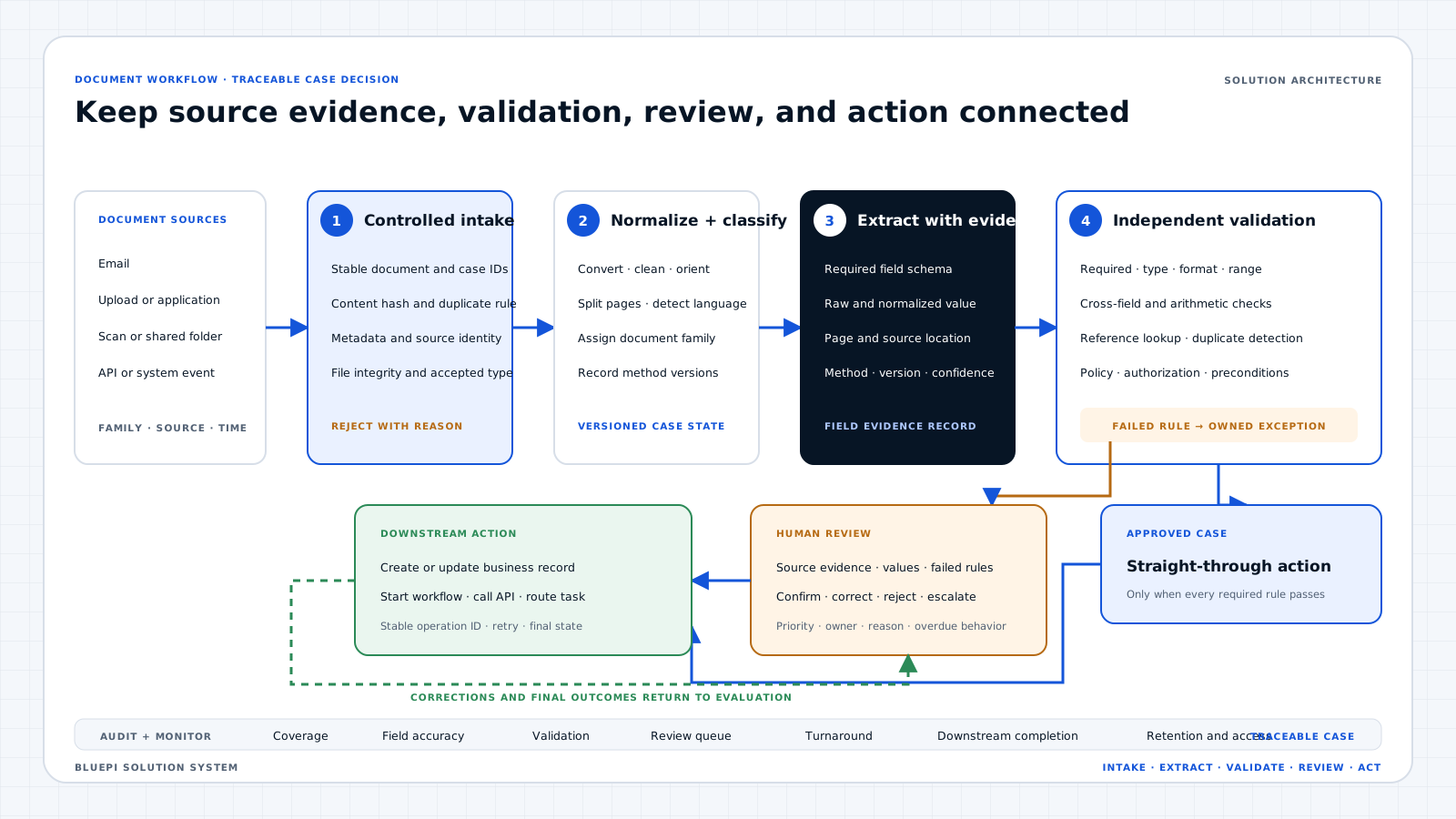
Document processing with evidence and owned exceptions
A production document workflow includes intake controls, stable case identity, normalization, classification, extraction evidence, independent validation, human review, downstream integration, audit, and retention.
The implementation can use deterministic parsing, templates, machine learning, language models, or a controlled combination selected by document family and risk.
Define accepted families, sources, formats, languages, layouts, required fields, metadata, duplicate behavior, sensitive-data controls, and the safe route for unsupported input.
Check extracted values against types, formats, ranges, cross-field rules, reference systems, duplicate records, policy, authorization, evidence, and downstream preconditions.
Give reviewers source evidence, failed rules, safe actions, priority, ownership, and overdue behavior. Use stable operation identifiers for downstream writes and retries.
When this is the right starting point
Good fit
One operating workflow has a named owner, a measurable baseline, and users who can judge whether the result improves.
Poor fit
The request is capacity-only staffing, an unowned demonstration, or a broad transformation without a first decision and finish condition.
Evidence produced during delivery
Open the part you need. Each section expands into the full delivery scope for that step.
Start with the document family, business action, source channel, expected volume, required turnaround, reviewer, downstream system, accepted formats, required fields, and consequence of a wrong or late result.
Each document receives a stable identifier, source timestamp, content hash, page record, and processing state. Normalization can include file conversion, image cleanup, orientation correction, page splitting, language detection, and document-family classification. The workflow records the normalization and classification versions used for each case.
The extraction schema defines every required field, data type, allowed format, whether the field can be absent, and how the value will be used. Each value can retain its document and page identifier, source location, extraction method and version, raw and normalized value, confidence, validation state, and exception reason.
The implementation can combine deterministic parsing, templates, machine learning, language models, or a controlled route selected by document type.
Extraction and validation remain separate steps. A value can be extracted correctly and still be invalid for the business process.
Reviewers see the source evidence, extracted and normalized values, failed rules, prior actions, and the safe decisions available for the case. The review contract defines queue priority, reviewer role, confirm or correct actions, rejection, requests for more information, escalation, required reasons, service expectation, overdue behavior, maker-checker controls, and final disposition.
Approved cases can create or update a business record, start a workflow, call an API, produce a notification, or route a task. Stable case and operation identifiers prevent repeated actions during retries. The workflow records request, response, failure state, retry, manual recovery, and final downstream status.
The audit record connects the source document, extracted fields, validation results, review actions, downstream operation, and final result. Measures can include document coverage, classification and field accuracy, false acceptance, straight-through completion, review and correction rate, queue age, turnaround, downstream completion, duplicate-action prevention, recovery behavior, reviewer effort, and case completion cost.
The workflow includes controlled intake, stable document and case identifiers, normalization, classification, evidence-backed field extraction, independent validation, owned human review, safe downstream integration, audit records, retention controls, and end-to-end monitoring.
Measure document coverage, classification and field accuracy, validation failure and false-accept rates, straight-through completion, review and correction rate, queue age, turnaround time, downstream acceptance, duplicate-action prevention, recovery behavior, reviewer effort, and final case completion.
Start with one document family, one reviewer group, and one downstream action. The first deployment needs representative samples, a manual baseline, accepted fields, validation rules, exception ownership, retention and access requirements, and measurable end-to-end completion.
We will review the owner, the baseline, the data path, the system boundary, and the route to go-live.
Discuss one workflow