
Good fit
One operating workflow has a named owner, a measurable baseline, and users who can judge whether the result improves.
Agent-accelerated software delivery
BluePi builds and modernizes enterprise applications with engineers who use governed coding agents to map code, implement scoped changes, verify behavior, and transfer ownership.
For teams building or changing live software
BluePi combines application engineers with governed coding agents so codebase analysis, scoped implementation, test creation, refactoring, and documentation can move through shorter feedback cycles.
The customer keeps the controls that matter. Architecture decisions, repository access, model-provider approval, security, acceptance criteria, merge authority, deployment, and ownership remain explicit.
When this is the right starting point
Good fit
One operating workflow has a named owner, a measurable baseline, and users who can judge whether the result improves.
Poor fit
The request is capacity-only staffing, an unowned demonstration, or a broad transformation without a first decision and finish condition.
Evidence produced during delivery
01
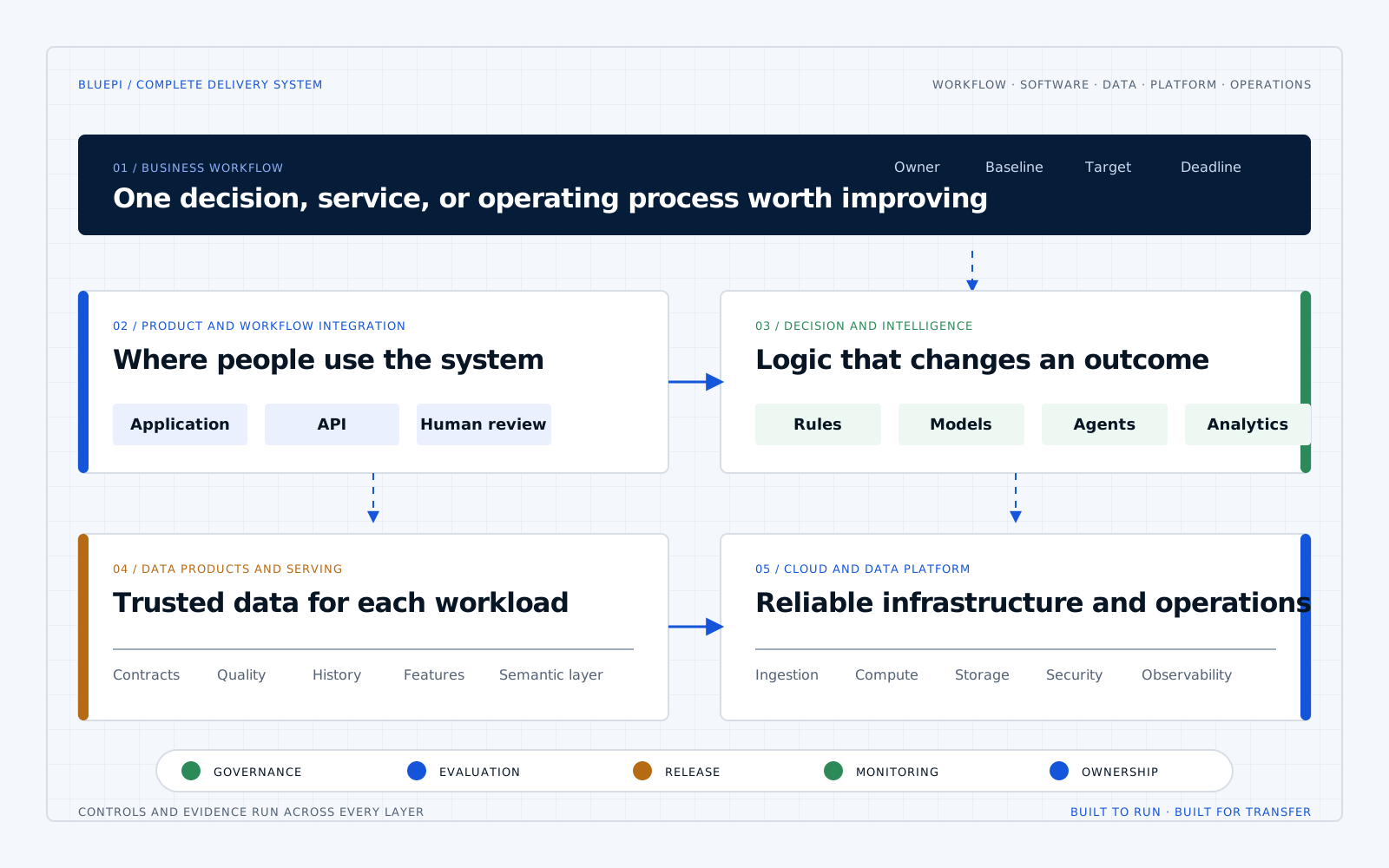
BluePi builds new web applications, internal platforms, product features, application programming interfaces, and workflow integrations. Enterprise application development starts with one user journey and a defined system boundary, then connects interface, domain logic, data, integrations, deployment, observability, and ownership.
02
Anthropic Claude Code, OpenAI Codex, and similar coding harnesses can help engineers inspect a repository, trace dependencies, implement bounded tasks, generate tests, refactor repeated patterns, and update technical documentation.
Agents work within customer-approved repository and data boundaries. They do not receive deployment credentials. Accountable engineers review every generated change before it can pass automated tests, security checks, and release controls.
03
Legacy application modernization begins by mapping business behavior, dependencies, interfaces, data, runtime configuration, deployment, and recovery. BluePi chooses the treatment for each component and preserves the behavior the business still needs.
Coding agents can assist with dependency discovery, framework updates, repetitive refactoring, adapter generation, parity tests, and documentation. Engineers own treatment selection, architecture seams, migration sequencing, cutover, and rollback.
04
AI-assisted software development uses the same acceptance standard as engineer-written code. The release path connects code review, automated tests, dependency and security checks, interface compatibility, performance, user acceptance, deployment evidence, and rollback.
05
A trade-data intelligence provider moved from multiple stores and applications to a central platform for master data, search, reporting, subscriptions, workflows, and system integration.
A global post-trade services provider replaced email and customer-relationship-management handoffs with centralized customer data, self-service, legacy synchronization, and single sign-on.
An Indian private-sector bank designed a configurable loan-origination platform with traceable application state, reusable integrations, and independently scalable services.
06
Bring one repository and one workflow. BluePi maps the code and operating boundary, records the current baseline, builds one end-to-end slice, verifies the behavior, and deploys through approved controls.
BluePi builds new web applications, internal platforms, product features, APIs, workflow integrations, and data or AI features. Delivery includes architecture, implementation, automated testing, deployment controls, observability, documentation, and ownership transfer.
BluePi engineers can use Anthropic Claude Code, OpenAI Codex, and similar coding harnesses for codebase mapping, scoped implementation, test generation, repeated refactoring, and technical documentation. Agents stay within customer-approved repository and data boundaries, and accountable engineers review every change.
Coding agents can assist with dependency discovery, framework updates, adapter generation, parity tests, repeated refactoring, and documentation. BluePi engineers choose the treatment, define architecture seams, preserve required business behavior, and own migration, cutover, and rollback.
Generated changes pass human code review, automated tests, dependency and security checks, interface compatibility checks, user acceptance, and the customer’s release controls. Coding agents do not receive deployment credentials or independent merge authority.
The customer receives the source code, automated tests, architecture and interface decisions, continuous integration and delivery configuration, verification evidence, monitoring, runbooks, and ownership records needed to operate and extend the application.
We will review the owner, the baseline, the data path, the system boundary, and the route to go-live.
Review an application backlog