
Decision contract
Define the target, grain, horizon, cadence, action window, owner, and cost of over- and under-forecasting before model selection begins.
Decision-ready forecasting
BluePi builds forecasting systems around one decision: what to buy, prepare, move, staff, or replenish at a defined product, location, and horizon. The system keeps the source cutoff, baseline, model version, planner override, and resulting action visible.
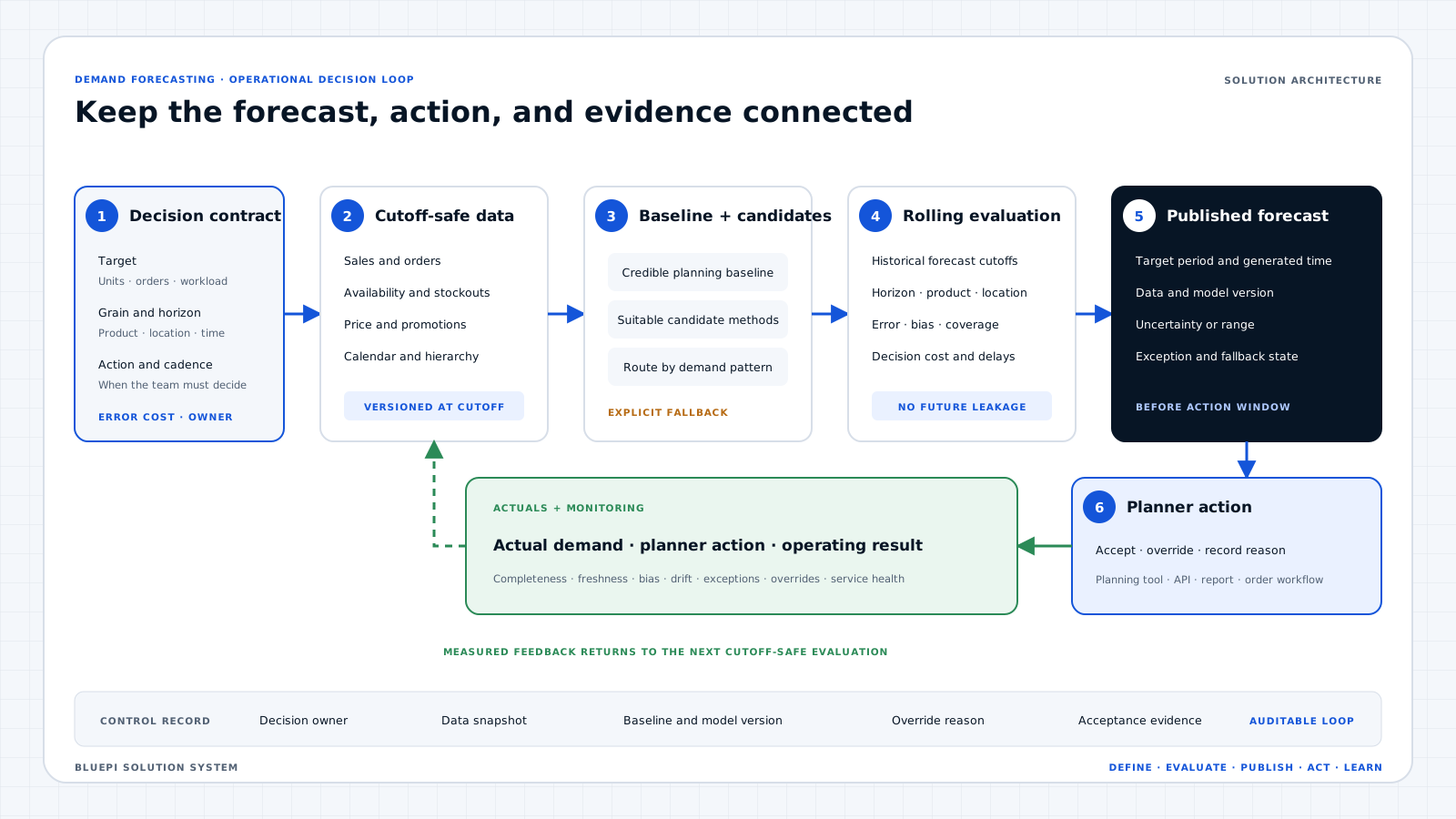
Forecasting connected to one operating decision
A planning team needs more than a model output. The team needs to know which decision the forecast serves, which information was available at the cutoff, how the result compares with the current baseline, and when an exception requires review.
BluePi connects the decision contract, cutoff-safe data, model and fallback route, rolling evaluation, forecast publication, planner action, and post-release monitoring.
Define the target, grain, horizon, cadence, action window, owner, and cost of over- and under-forecasting before model selection begins.
Compare a credible baseline and suitable candidates across historical cutoffs, operating segments, delayed data, sparse demand, promotions, and the costs attached to error.
Publish a versioned forecast before the decision window closes, expose exceptions and uncertainty, record overrides, and monitor the downstream result.
When this is the right starting point
Good fit
One operating workflow has a named owner, a measurable baseline, and users who can judge whether the result improves.
Poor fit
The request is capacity-only staffing, an unowned demonstration, or a broad transformation without a first decision and finish condition.
Evidence produced during delivery
Open the part you need. Each section expands into the full delivery scope for that step.
A forecast has operating meaning only after the team defines the target, grain, horizon, cadence, action window, owner, and cost of error. BluePi records those choices before selecting a forecasting method.
Each historical training and evaluation record must contain only information available before its original forecast cutoff. BluePi aligns orders, sales, availability, price, promotions, calendars, product and location hierarchies, and approved external signals to that boundary.
Candidate statistical and machine-learning methods are evaluated against a baseline on the same historical cutoffs, horizons, and operating slices. The selected route can vary by demand pattern, while sparse or unsupported segments retain an explicit fallback.
One aggregate accuracy score can hide the locations, products, horizons, and demand conditions where the system fails. Reviews therefore connect error, bias, coverage, and decision cost to the operating grain.
The forecast must reach a planning tool, API, report, or order workflow before the action window closes. Each published result carries its target period, data and model version, generation time, uncertainty or range, and exception state. Planner overrides retain the reason for changing the recommendation.
Production monitoring covers source completeness, forecast freshness, bias, drift, exception volume, override behavior, service availability, and the downstream result. Actual demand and planner action return to the evaluation record so reviews can separate model error from data failure or operating change.
BluePi holds Indian patent 388811 for retail demand forecasting. The retail replenishment and hourly restaurant forecasting case studies show the same approach in live use. A first deployment should use one bounded category, region, store group, or planning horizon with a live data path, an operating owner, a credible baseline, acceptance measures, and a defined route into the planning workflow.
The system includes a defined decision and forecast grain, cutoff-safe data, a credible baseline, suitable candidate methods, rolling backtests, segment-level evaluation, forecast publication, exception and override handling, monitoring, and an operating owner.
Method selection follows the decision, horizon, hierarchy, demand pattern, and available history. Every candidate is evaluated against the same baseline and historical cutoffs. Sparse, intermittent, promotional, or newly introduced segments can use a separate route or an explicit fallback.
Start with one category, region, store group, or planning horizon. The first deployment needs a live data path, a current planning baseline, an operating user, acceptance measures, and a defined route for the forecast to enter the decision workflow.
We will review the owner, the baseline, the data path, the system boundary, and the route to go-live.
Discuss one workflow