
01 · Repeatable release pipeline
CodePipeline reduced manual release steps and made build, deployment, and rollback behavior easier to trace.
Customer work · Technology
InfoDrive India’s private-cloud application had manual deployments, limited scaling, and weak operating visibility. BluePi moved the application to AWS, automated delivery, used load testing to right-size capacity, introduced autoscaling, and added application and infrastructure monitoring.
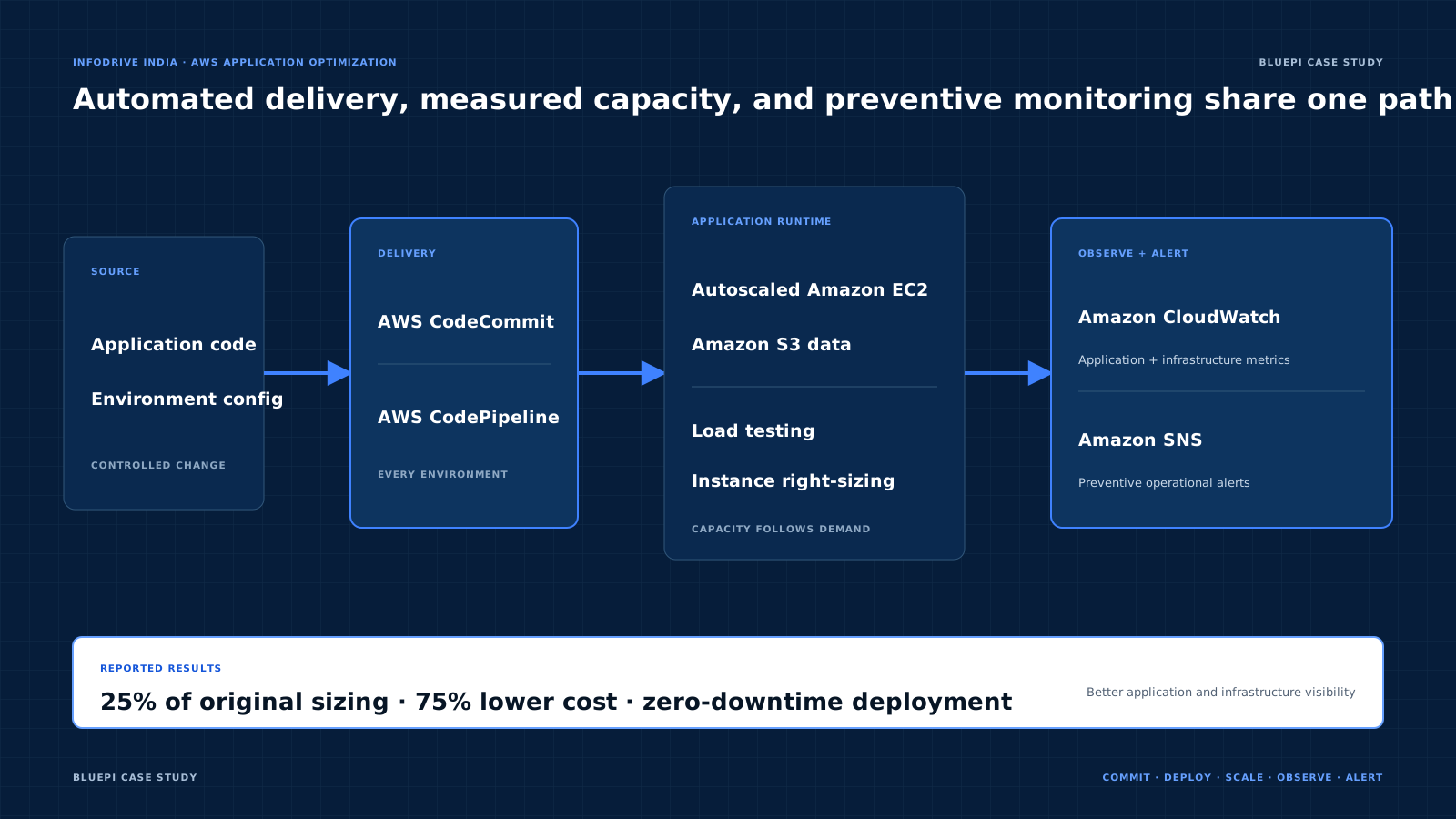
InfodriveIndia faced rising traffic, slower application behavior, manual releases, and limited evidence beyond server alarms. BluePi moved the application to AWS and improved deployment, autoscaling, monitoring, and notification paths.
01 · Repeatable release pipeline
CodePipeline reduced manual release steps and made build, deployment, and rollback behavior easier to trace.
02 · Demand-based capacity
Autoscaling on AWS adjusted capacity around workload signals instead of fixed sizing for occasional peaks.
03 · Earlier service response
CloudWatch and SNS gave the team clearer application and infrastructure signals, reducing service interruptions through earlier detection and response.
BluePi moved the workload to AWS, placed application assets on EC2 and S3, added a CodePipeline release path, used autoscaling for variable demand, and connected CloudWatch monitoring to SNS notifications.
A repeatable pipeline reduced manual steps and made build, deployment, and rollback behavior easier to trace.
Capacity followed workload signals instead of remaining fixed for occasional peaks.
Monitoring and notifications identified conditions that required investigation and supported a more proactive operating rhythm.
Where this pattern fits
This case reflects BluePi’s cloud-engineering foundation. The same principles apply when modernizing data and AI services whose release, cost, scale, and observability must work together.
Use these prompts to decide whether the case fits your operating problem and what a first deployment should prove.
A practical first step is a workload and release review. BluePi maps current capacity against measured demand, traces one release from code change to live service, and inventories the monitoring gaps. The review produces a bounded migration and automation plan with a cost baseline and service measures attached.
Open a section to review the customer problem, implementation, business change, and architecture.
The application ran on a private cloud with manual deployments, fixed capacity, and limited monitoring. Releases were slow and prone to error, workload changes caused performance bottlenecks, and the team often learned about issues from users before any alert fired.
BluePi migrated the application to AWS and rebuilt the operating path around it. Amazon EC2 autoscaling adjusts capacity with demand, Amazon S3 stores application data, AWS CodePipeline automates build and deployment, and Amazon CloudWatch with Amazon SNS gives the team monitoring and real-time alerts for critical events.
The application ran at 25 percent of its original sizing, equivalent to a 75 percent overall cost reduction. Deployments now ship without downtime, and monitoring lets the team find and fix issues earlier.
Cost, performance, deployment risk, and visibility had to improve together. Right-sizing worked because autoscaling matched capacity to measured demand, and deployment automation paid off once releases could run without downtime. Monitoring and alerts closed the loop so the team could see the effect of each change.
Releases stopped being manual events, and capacity stopped being a fixed guess. The team works from CloudWatch evidence and SNS alerts instead of user reports, so issues surface earlier and service interruptions shortened.
Source code moved through AWS CodeCommit and AWS CodePipeline into autoscaled Amazon EC2 environments. Amazon S3 stored application data, while Amazon CloudWatch application and infrastructure metrics fed Amazon SNS alerts for preventive action.