Migration contract
Connect each source object to workload, dependency, owner, business meaning, target mapping, treatment, validation, coexistence, cutover, rollback, and retirement state.
Estate to validated target
BluePi moves data workloads in dependency-closed waves. Each object and workload retains its source meaning, conversion state, exception owner, validation evidence, cutover decision, rollback path, and retirement status.
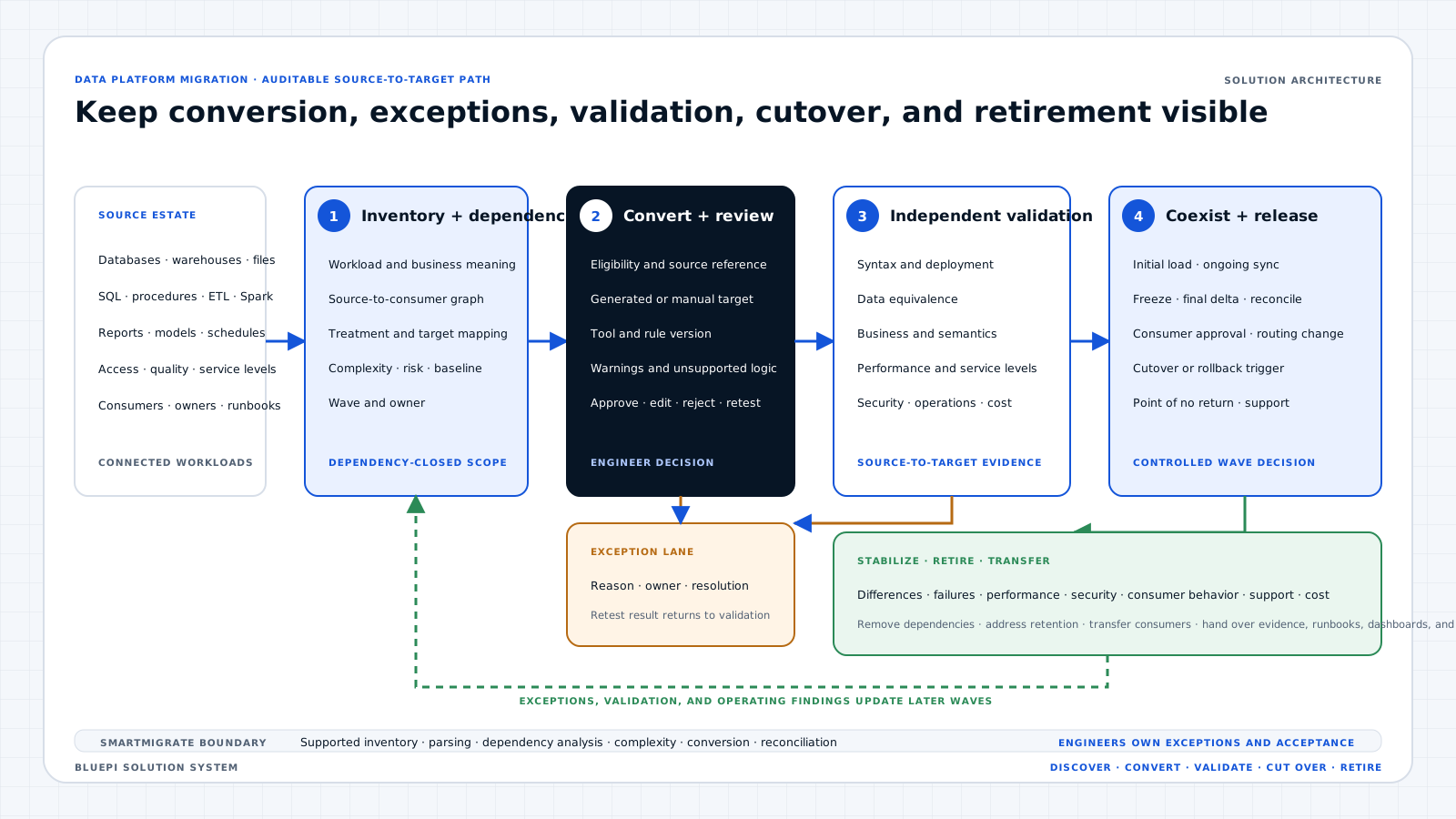
Migration with a reviewable path from source estate to target approval
BluePi treats migration as a workload and evidence program. Inventory, dependency analysis, treatment, conversion, exceptions, validation, synchronization, cutover, rollback, retirement, and transfer share one traceable record.
SmartMigrate can automate supported discovery, conversion, and reconciliation. Engineers own business meaning, exceptions, target behavior, release decisions, and acceptance.
Connect each source object to workload, dependency, owner, business meaning, target mapping, treatment, validation, coexistence, cutover, rollback, and retirement state.
Keep source reference, generated target, tool and rule version, warnings, unsupported constructs, review state, engineer decision, exception owner, and retest evidence.
Record load, synchronization, final validation, consumer approval, cutover, rollback, stabilization, support, source retirement, and target operating ownership for every wave.
When this is the right starting point
Good fit
One operating workflow has a named owner, a measurable baseline, and users who can judge whether the result improves.
Poor fit
The request is capacity-only staffing, an unowned demonstration, or a broad transformation without a first decision and finish condition.
Evidence produced during delivery
Open the part you need. Each section expands into the full delivery scope for that step.
The migration inventory covers databases, warehouses, files, tables, views, SQL, procedures, ETL, Spark, notebooks, reports, semantic models, schedules, access, data quality, service levels, incidents, costs, consumers, owners, and operating procedures. A dependency graph connects objects to the workloads and business use they support.
Each workload and object receives a migration, refactor, replacement, retirement, defer, or exception treatment. The record includes source and target mapping, business meaning, complexity, dependency impact, expected automation, manual review, coexistence, validation, cutover, rollback, retirement, and owner.
The team captures source data, performance, security, schedule, service, and cost baselines before conversion.
A wave groups workloads that can convert, validate, cut over, and stabilize together. It records entry and exit criteria, included and excluded scope, source and target owners, conversion sequence, data load, synchronization, validation roles, user readiness, cutover window, rollback trigger, support, and retirement conditions.
Automation can inventory, parse, classify, score complexity, convert supported objects, and generate reconciliation evidence. Every generated result keeps its source reference, target output, tool and rule version, warnings, unsupported constructs, review state, engineer decision, and retest result.
SmartMigrate can accelerate supported inventory, conversion, and reconciliation. Engineers retain responsibility for business meaning, exceptions, target tuning, validation, performance, security, cutover, and acceptance.
Validation covers syntax and deployment, data equivalence, business and semantic equivalence, workload behavior, performance and service levels, security and governance, operability, and cost.
Where source and target coexist, the team defines the initial load, ongoing synchronization, freeze, final delta, reconciliation checkpoint, approval, routing change, rollback trigger, and point of no return.
After cutover, stabilization tracks differences, failures, performance, security, consumer behavior, support load, and cost. Source workloads retire only after dependencies, retention, archive, access, and consumer-transfer conditions are met. Repositories, mappings, exception records, validation evidence, runbooks, dashboards, cost controls, and known limitations transfer to named owners.
BluePi inventories connected workloads, assigns treatments, captures baselines, plans dependency-closed waves, converts with reviewable automation, validates source-to-target behavior, synchronizes coexistence, and runs controlled cutover, rollback, stabilization, retirement, and transfer.
SmartMigrate can accelerate supported inventory, parsing, dependency analysis, complexity scoring, conversion, and reconciliation. BluePi engineers own business meaning, unsupported constructs, exceptions, target tuning, validation, performance, security, cutover, rollback, and acceptance.
Start with one representative workload family. Connect its objects and dependencies, choose the target treatment, capture the source baseline, convert supported scope, record exceptions, reconcile behavior, and exercise coexistence, cutover, rollback, and operating ownership.
We will review the owner, the baseline, the data path, the system boundary, and the route to go-live.
Plan the migration path