
Behavior contract
Connect code, schedules, data samples, control tables, incident history, report outputs, operator workarounds, business rules, dependencies, consumers, and owners.
Rule recovery to retired source
BluePi treats legacy extract, transform, and load pipelines as operating software. The modernization record connects source and target contracts, business rules, schedules, dependencies, failure behavior, operator workarounds, validation, cutover, rollback, and retirement.
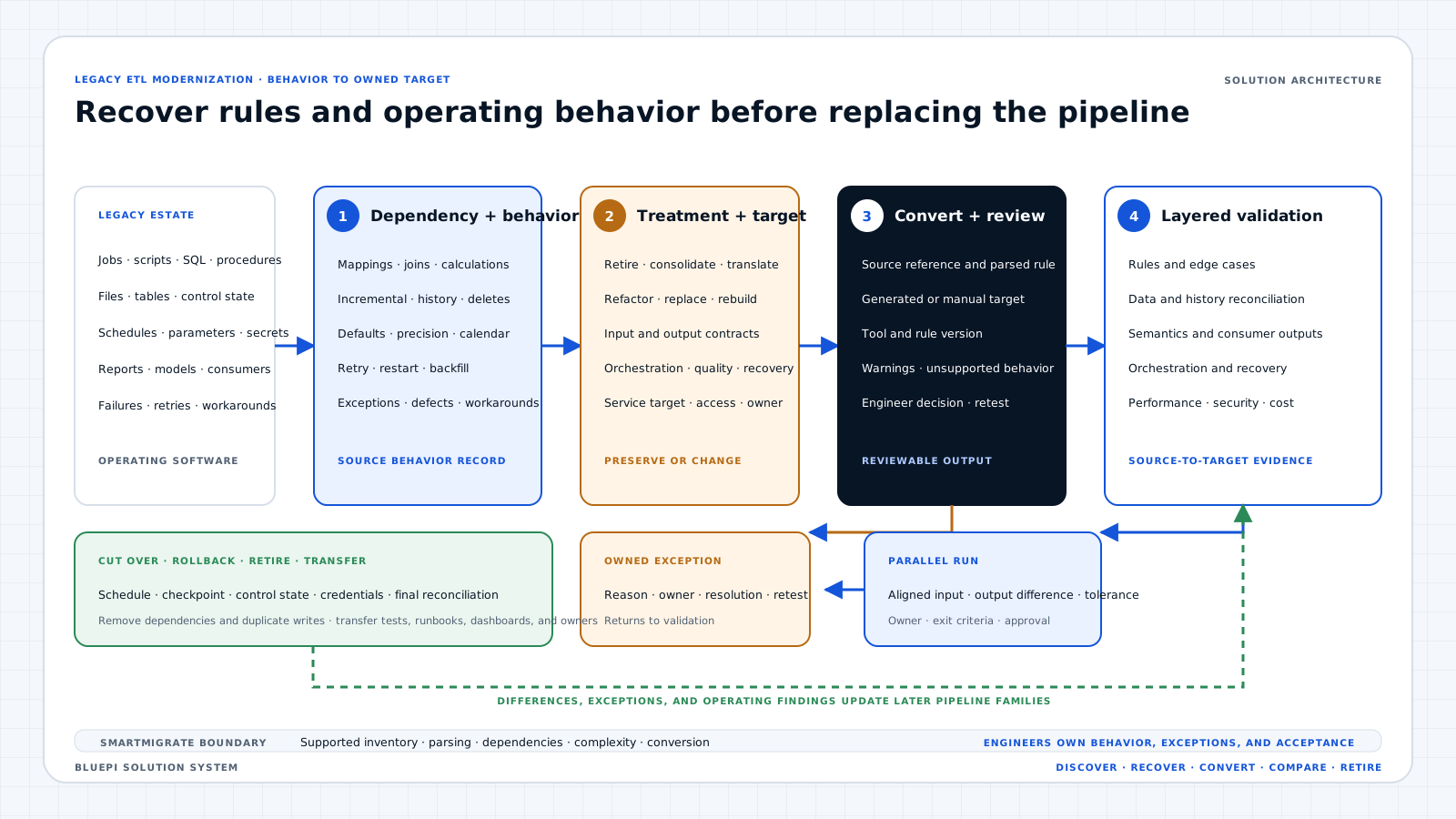
Recover behavior before replacing the pipeline
Legacy ETL jobs carry mappings, calculations, schedules, control state, workarounds, recovery behavior, and consumer assumptions. BluePi records that behavior before choosing what to retire, consolidate, translate, refactor, replace, or rebuild.
The target path combines a reviewed conversion record, layered tests, comparable runs, controlled cutover, rollback, retirement, and operating transfer.
Connect code, schedules, data samples, control tables, incident history, report outputs, operator workarounds, business rules, dependencies, consumers, and owners.
Test rules, data, semantics, consumer outputs, orchestration, recovery, performance, security, operations, and cost against aligned source and target runs.
Record cutover, rollback, schedule and checkpoint transfer, downstream dependency removal, retention, credential shutdown, duplicate-write prevention, consumer transfer, and ownership.
When this is the right starting point
Good fit
One operating workflow has a named owner, a measurable baseline, and users who can judge whether the result improves.
Poor fit
The request is capacity-only staffing, an unowned demonstration, or a broad transformation without a first decision and finish condition.
Evidence produced during delivery
Open the part you need. Each section expands into the full delivery scope for that step.
The inventory covers pipelines, jobs, scripts, SQL, procedures, notebooks, files, control tables, schedules, parameters, secrets, source and target structures, reports, models, consumers, service levels, incidents, costs, and owners. It connects job dependencies, data movement, triggers, shared code, identities, critical windows, quality checks, and manual recovery steps.
BluePi combines code analysis, runtime logs, schedules, data samples, control records, incident history, report outputs, and operator interviews.
Each pipeline receives a retire, consolidate, translate, refactor, replace, rebuild, or defer treatment. The target contract defines inputs, outputs, keys, grain, schema, semantics, incremental behavior, orchestration, checkpoints, quality, failure handling, recovery, service targets, access, deployment, rollback, and owners.
SmartMigrate can assist with supported inventory, parsing, dependency analysis, complexity scoring, and conversion. Generated output retains the source reference, parsed behavior, target output, tool and rule version, warnings, unsupported constructs, confidence, review state, engineer decision, exception owner, and retest result. Engineers own business meaning, target design, orchestration, performance, security, and exceptions.
Layered validation covers mappings and rules, data reconciliation, semantics and consumer outputs, orchestration and recovery, performance, service behavior, security, operations, and cost.
Where required, source and target run in parallel with aligned inputs, source position, schedules, parameters, and comparison windows. Each run records source output, target output, tolerance, difference, known exception, owner, resolution, and retest. Exit criteria define coverage, acceptable differences, critical-window behavior, user approval, and comparable-run requirements.
The cutover runbook covers source and target freeze, final source position, data load, schedule and trigger transfer, checkpoint and control-table transfer, final reconciliation, approval, routing and credential changes, monitoring, rollback, point of no return, communication, and incident response.
Legacy jobs retire only after downstream dependencies move, retention needs are resolved, schedules and credentials are disabled, duplicate writes are prevented, consumers are notified, and the decision is recorded. Repositories, mappings, behavior records, exceptions, tests, evidence, runbooks, dashboards, deployment paths, and support ownership transfer to the target team.
Source code does not contain schedules, control-table state, runtime workarounds, incident history, accepted exceptions, report use, and operator knowledge. The behavior record combines those sources before treatment and conversion decisions.
Align source inputs, source position, schedules, parameters, and comparison windows. Test mappings, rules, counts, keys, history, corrections, consumer outputs, recovery, runtime, service levels, security, and cost. Record each difference, tolerance, owner, resolution, and retest.
SmartMigrate can accelerate supported inventory, parsing, dependency analysis, complexity scoring, and conversion. BluePi engineers own recovered business meaning, unsupported behavior, exceptions, target design, validation, parallel-run acceptance, cutover, rollback, and retirement.
We will review the owner, the baseline, the data path, the system boundary, and the route to go-live.
Plan the migration path